Supercritical CO2
Today, businesses across all industries are striving to reduce their carbon footprints. This includes exploring sustainable, eco-friendly extraction processes as alternatives to petrochemical solvents. One promising option is supercritical CO2, which can play a significant role in the eco-design of cosmetic ingredients.
Challenges with traditional solvents
Petroleum-based solvents have been widely used for extracting plant-derived molecules due to their effectiveness. However, their use has significant drawbacks, including resource depletion and potential toxicity to humans and the environment. Recognizing these issues, companies are now seeking greener extraction methods to reduce their environmental impact.
The paradox of CO2
While industrial CO2 is often associated with climate change and pollution, in its supercritical state, it becomes an ideal solvent for extracting plant molecules. This technology not only reclaims CO2 that would otherwise be released into the atmosphere but also makes use of it in a productive way. Currently, 90% of industrial applications of supercritical CO2 (scCO2) are for the extraction of natural molecules, making it a sustainable technology that conserves natural resources and reduces environmental footprints.
The concept of supercritical fluids
Introduced by Thomas Andrews in 1869, the supercritical state adds to the existing states of matter: solid, liquid, and gas. A fluid becomes supercritical when heated above its critical temperature and compressed above its critical pressure. This state combines the properties of liquids and gases, offering several advantages:
High Density: Facilitates the dissolution of target compounds.
Low Viscosity: Enables easy penetration into plant matrices.
Intermediate Diffusion Coefficient: Efficiently transports molecules from inside the plant to the outside.
Although supercritical fluids became widely used only in the 1980s, they are now essential in various fields, including essential oil extraction, drug purification, and decaffeination. Other eco-friendly extraction methods, such as NaDES are also emerging in cosmetics.
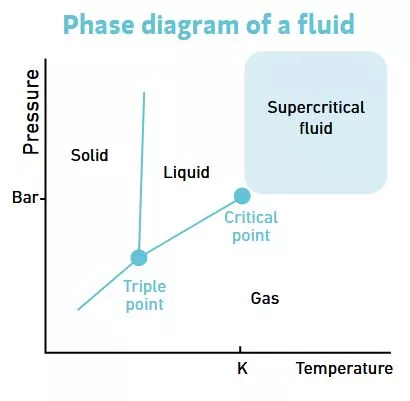
scCO2: A versatile solvent
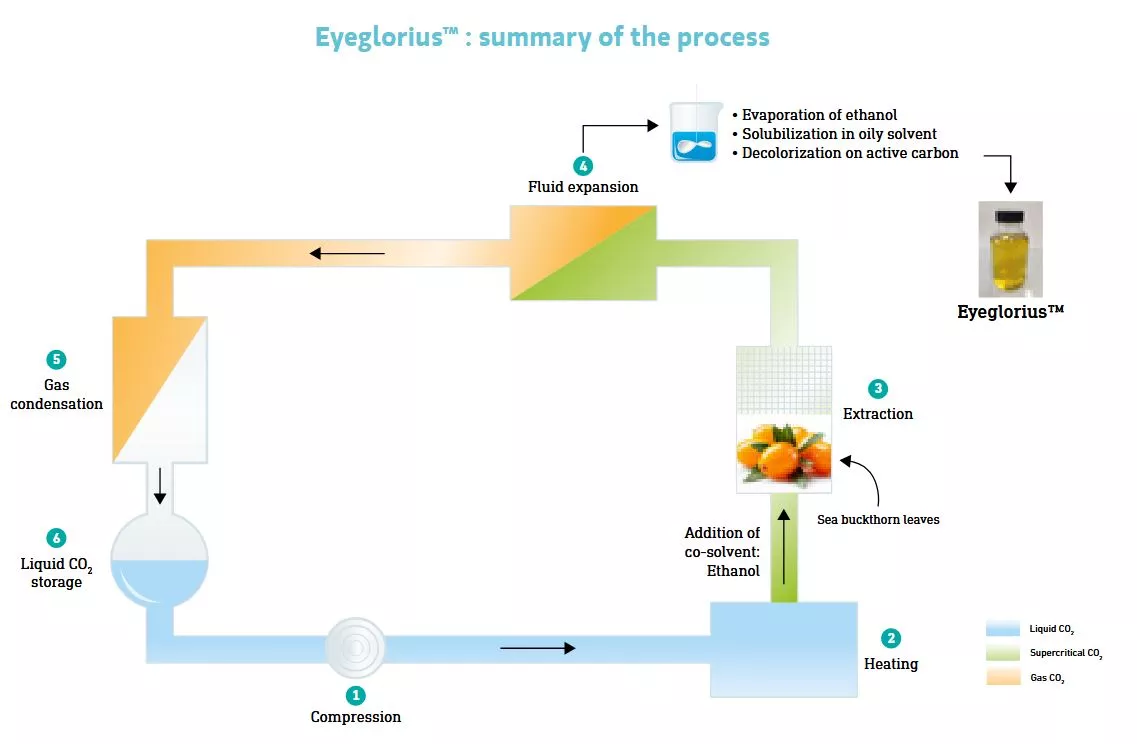
scCO2 is particularly attractive due to its ability to reach a supercritical state at relatively low temperatures and pressures, aligning with industrial, financial and energy constraints. It also preserves the integrity of heat-sensitive compounds. By adjusting pressure and temperature, the properties of scCO2, such as density and solvating power, can be modified, making it suitable for various applications. During extraction, CO2 is separated from the solute and stored in a closed circuit for re-injection, providing a sustainable alternative to organic solvents and enabling high-performance, 100% recyclable extractions.
Applications by Gattefossé
The cosmetics industry has quickly embraced the advantages of CO2sc, including the purity of extracts and environmental benefits. Gattefossé, a pioneer in this field, first used supercritical CO2 twenty years ago for Gatuline® Derma-Sensitive. The research team continues to innovate with this technology, developing new ingredients like Eyeglorius™.
Gatuline® Derma-Sensitive
Gatuline® Derma Sensitive is a natural active designed to comfort and protect…
- Actives